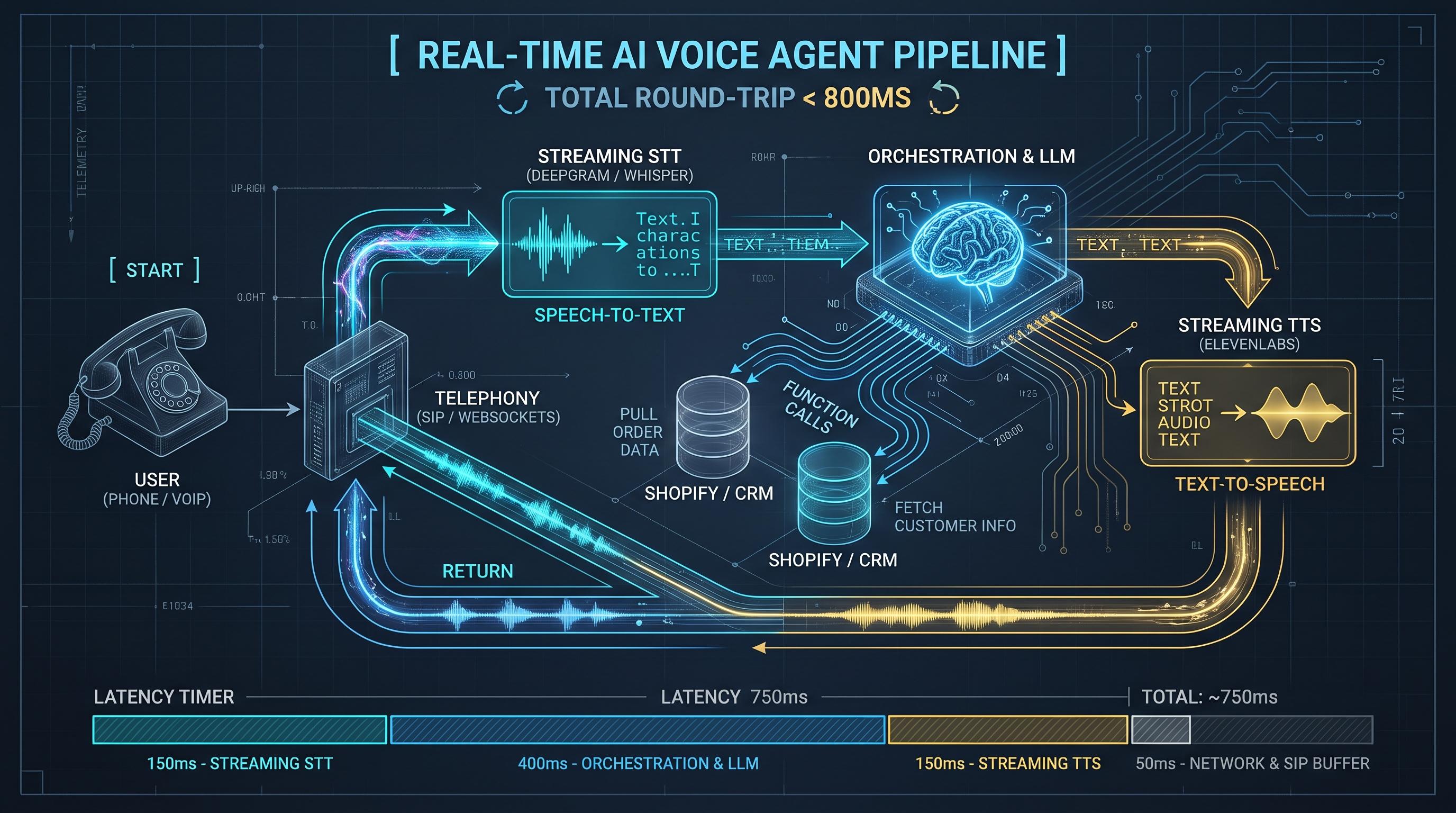
Cloud hosted vs self hosted llm enterprise compliance architecture comparison on modern server infrastructure
Is pure on-premise AI truly safer for your enterprise data? We break down the real trade-offs between cloud and self-hosted LLM compliance.

When enterprise security teams evaluate large language models, the default reaction is often predictable: isolate everything. Traditional IT wisdom suggests that keeping models entirely on private bare-metal infrastructure is the only bulletproof way to meet regulatory standards. However, in the debate over cloud hosted vs self hosted llm enterprise compliance, the absolute belief in self-hosting as the superior compliance model is outdated.
For most modern enterprises, including luxury retail brands and hardware manufacturers deploying automation across customer operations, building a purely self-hosted LLM stack introduces massive operational vulnerability and runaway overhead. Managed cloud deployments, when paired with zero-retention enterprise agreements and selective local routing, offer a more auditable, cost-efficient, and secure compliance posture.
Here is an analysis of both operational models, the actual compliance realities behind them, and how to structure your language model architecture without crippling your balance sheet.
The Realities of Cloud Hosted vs Self Hosted LLM Enterprise Compliance
Compliance is not just about where weights and memory banks sit physically. It is an ongoing guarantee of data privacy, access control, auditability, uptime, and residency under frameworks like GDPR, HIPAA, SOC 2, and ISO 27001.
Self-hosting advocates argue that total physical isolation eliminates data leakage. If your model runs inside a private cluster in your data center, no prompt data leaves your perimeter. That is true on paper. But compliance requires far more than physical isolation. It demands model security, vulnerability patching, hardware redundancy, credential governance, and strict access logging.
When a team hosts an open-source model like Llama on private infrastructure, the entire compliance burden falls on their internal engineers. You become responsible for container vulnerabilities, memory management flaws, data pipeline leakage, and hardware failures.
Conversely, enterprise-tier cloud providers sign business associate agreements (BAAs) and data processing addendums (DPAs) that legally guarantee zero prompt retention. Prompts processed through their enterprise APIs are not stored, are not accessible by provider personnel, and are never used to retrain underlying models. From an auditor's perspective, an independently verified SOC 2 Type II attestation from a major cloud vendor is often far simpler to validate than a homegrown on-premise cluster.
The Hidden Operational Pitfalls of Self-Hosting
Many tech manufacturers and high-end retail brands initially choose self-hosted deployments out of an abundance of caution, only to hit three critical operational hurdles.
1. The Capital Expenditure Spiral
Running enterprise-grade inference locally requires substantial hardware investment. Procuring clusters of enterprise GPUs demands high initial capital, reliable power delivery, specialized liquid cooling, and months of hardware lead time. Beyond procurement, high-end infrastructure depreciates quickly as new silicon generations emerge.
If your inference pipeline runs at 20% capacity overnight, you still pay for 100% of the hardware, cooling, and real estate. In contrast, cloud hosted enterprise APIs charge solely for consumed tokens.
2. The Maintenance Deficit
Serving large language models is not like hosting a standard relational database. Quantization, vLLM optimizations, memory context window management, and pipeline parallelization require dedicated machine learning platform engineers. When an exploit emerges in a popular inference framework or serving library, your internal team must patch it immediately. If your engineering bandwidth is consumed by patching internal inference clusters, your core business workflows fall behind.
3. Slower Model Upgrades
Foundational models evolve every few months. In an enterprise cloud setup, adopting a new, faster, more capable model requires changing an API endpoint string and running automated regression tests. In a self-hosted setup, upgrading models often requires re-engineering model parallelization, re-evaluating memory limits, updating driver stacks, and retraining custom weights.
Where Pure Self-Hosting Still Makes Sense
Fairness requires acknowledging the specific environments where self-hosting remains mandatory:
- Sovereign defense and air-gapped systems where public internet connectivity is legally prohibited.
- Specific medical diagnostic systems where patient records cannot cross network boundaries under any contractual framework.
- Ultra-high throughput scenarios running static, repetitive tasks where hardware is fully saturated 24/7, making hardware amortization cheaper than cloud token fees.
Unless your enterprise operates inside these specific boundaries, running exclusively self-hosted models for general compliance is often an over-engineered risk.
The Winning Strategy: A Hybrid Compliance Pipeline
Instead of treating cloud and self-hosted models as mutually exclusive, resilient organizations build a tiered, hybrid architecture. This framework satisfies security teams while protecting operational margins.
Tier 1: Local Pre-processing and PII Masking
Run small, specialized open-source models or deterministic regex pipelines locally inside your application edge. This layer handles two tasks:
- Stripping personally identifiable information (PII), customer identifiers, and proprietary serial numbers from prompts.
- Classifying queries by sensitivity.
Data that strictly requires on-premise storage stays on-premise and gets handled by small local models. Non-sensitive or tokenized data is routed to faster, more capable enterprise cloud endpoints.
Tier 2: Dedicated Enterprise Cloud APIs
For complex reasoning, multi-turn customer dialogues, and catalog automation, forward the sanitized prompts to enterprise cloud providers under signed DPAs. You gain the reasoning power of frontier models without exposing raw customer records.
This architecture directly resolves the core problem many teams encounter when scaling workflows: unchecked infrastructure costs. By routing routine queries to lean, cheaper models and reserving heavy reasoning models for high-value requests, you avoid the severe financial drag of over-provisioned infrastructure. For a deeper breakdown of smart routing, token caching, and request pruning, read our guide on how to reduce LLM API costs in production.
Tier 3: Immutable Logging and Observability
True compliance rests on observability. Maintain an independent, cryptographically signed log of every request payload, user ID, latency metric, and response hash. Whether an inference call executes on a private rack or an enterprise cloud pod, your compliance officer should be able to trace who initiated the call, what data was sent, and where the output traveled.
Technical Criteria for Evaluating Enterprise LLM Options
Before deciding between a cloud contract and a rack purchase, evaluate both options against these practical requirements:
- Zero-Data Retention Guarantees: Does the cloud provider contractually guarantee immediate memory clearance after inference completion?
- Data Residency Isolation: Can you pin your inference instances to specific geographic zones (such as EU-only or US-only regions)?
- Hardware Redundancy: If your primary inference node fails, does your self-hosted setup have failover capacity, or does it bring down production workflows?
- Audit Trail Completeness: Can your logging system produce comprehensive access reports for security audits without manual log assembly?
- Unit Economics at Scale: Have you calculated the true cost of GPU depreciation, staff maintenance hours, and energy consumption against pure token consumption?
The Bottom Line
Enterprise compliance is not defined by where your servers live, but by how rigorously your data flow is controlled. Building a private data center just to deploy an enterprise assistant or automate product descriptions is usually an expensive way to solve a problem that modern cloud security contracts have already resolved. Build an intelligent hybrid pipeline, keep your data sanitization tight, and reserve on-premise hardware for what truly cannot leave your walls.
If you want to integrate enterprise-grade AI into your operational workflows without taking on unmanageable infrastructure costs, XEONTRIX designs custom automated systems and enterprise AI integrations that balance compliance, performance, and efficiency. Book a free 30-minute AI strategy consultation to evaluate your architecture.
Questions people ask
What is the primary compliance advantage of self-hosted LLMs?
Self-hosted LLMs keep data completely within your internal network, ensuring that prompts and proprietary data never traverse public internet infrastructure or third-party servers.
Do enterprise cloud LLM providers use customer data to train models?
No. Major enterprise cloud LLM providers offer explicit agreements (such as DPAs and BAAs) that legally guarantee customer prompts and completions are not used to retrain underlying foundational models.
How does a hybrid LLM architecture protect data privacy?
A hybrid architecture uses local, lightweight scripts or models to redact personally identifiable information and sensitive records before routing the sanitized request to high-performance cloud APIs.
Is self-hosting an LLM always cheaper than cloud API calls?
No. Self-hosting requires high upfront hardware costs, cooling, energy, and ongoing specialized engineering salaries. For variable or moderate workloads, enterprise cloud APIs are usually far more cost-effective.